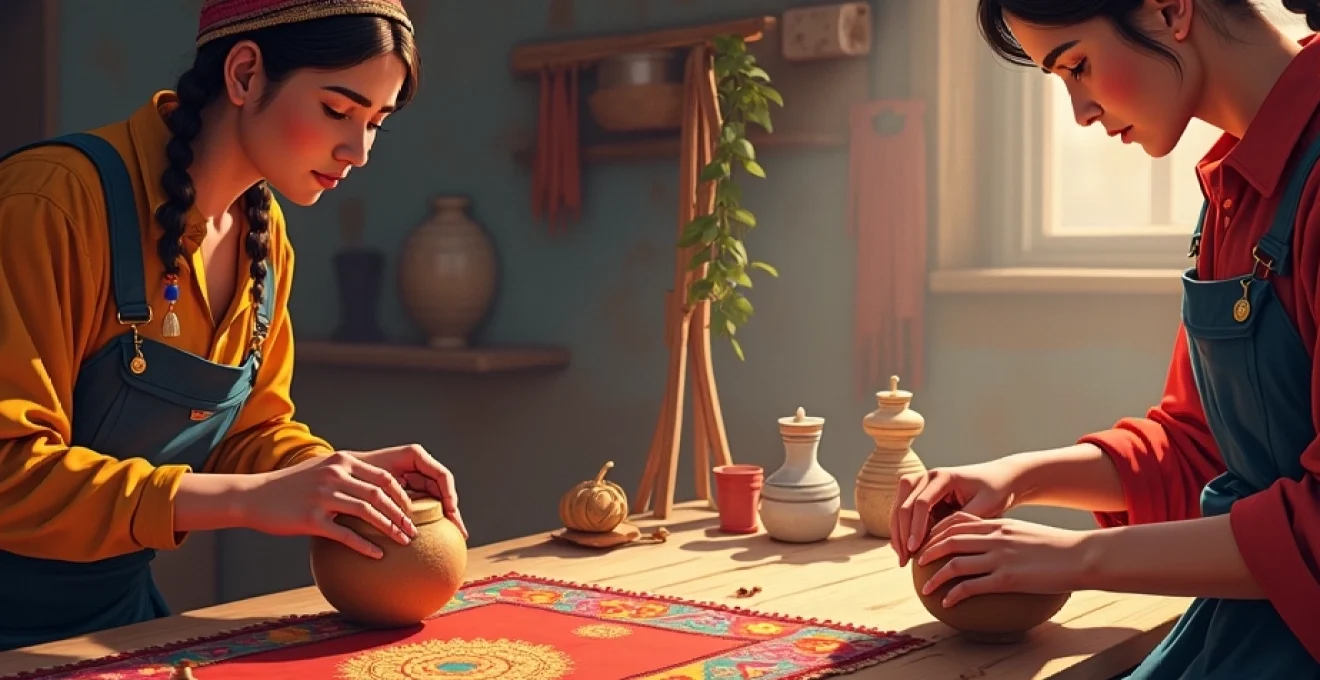
Folk art serves as a living bridge between past and present, carrying the essence of cultural identity through generations of artistic expression. These traditional art forms, deeply rooted in community experiences and local customs, continue to thrive as powerful symbols of cultural heritage worldwide. From intricate textile weaving to ceremonial pottery, folk art encompasses a vast spectrum of creative practices that reflect the values, beliefs, and daily life of communities across the globe.
The significance of folk art extends far beyond its aesthetic appeal. These artistic traditions function as cultural repositories, preserving historical narratives, spiritual beliefs, and social customs that might otherwise be lost to time. In an increasingly globalized world, folk art stands as a testament to the diversity of human creativity and the importance of maintaining distinct cultural identities. Each brushstroke, carved detail, or woven pattern tells a story that connects contemporary practitioners to their ancestral roots.
Contemporary society recognizes folk art not merely as decorative objects but as vital expressions of cultural authenticity. Museums, galleries, and cultural institutions worldwide have elevated folk art to prominence, acknowledging its role in maintaining cultural diversity and fostering cross-cultural understanding. This recognition has sparked renewed interest among younger generations, who see these traditional practices as meaningful alternatives to mass-produced commercial art.
Traditional techniques passed down through generations
The transmission of folk art techniques represents one of humanity’s oldest forms of knowledge transfer, creating an unbroken chain of artistic wisdom that spans centuries. Master artisans dedicate decades to perfecting their craft, developing an intimate understanding of materials, tools, and processes that cannot be replicated through formal education alone. This apprenticeship system ensures that subtle nuances and traditional methodologies remain intact, preserving the authenticity that distinguishes folk art from contemporary manufactured goods.
Regional variations in technique development reflect the unique environmental and cultural factors that shape each community’s artistic expression. Geographic isolation often leads to highly specialized methods that become signature elements of particular folk art traditions. These variations demonstrate how artists adapt universal human creativity to local conditions, creating distinctive styles that serve as cultural fingerprints for their communities.
Intricate weaving methods preserve cultural heritage
Textile weaving represents one of the most complex and symbolically rich forms of folk art, with techniques that require years of dedicated practice to master. Traditional looms, often constructed using locally sourced materials, produce fabrics that carry deep cultural significance through their patterns, colors, and construction methods. Each weaving tradition incorporates specific symbolic elements that convey stories, mark social status, or invoke spiritual protection.
The complexity of traditional weaving extends beyond mere technique to encompass sophisticated understanding of natural dyes, fiber preparation, and pattern mathematics. Master weavers possess encyclopedic knowledge of plant-based colorants, mordants, and dyeing processes that create the vibrant hues characteristic of their regional traditions. This knowledge encompasses not only the technical aspects of color production but also the seasonal timing required for optimal results and the cultural significance of specific color combinations.
Pottery techniques showcase ancestral knowledge
Clay working traditions demonstrate the profound relationship between folk artists and their natural environment, with techniques refined over millennia to work harmoniously with local clay deposits and firing conditions. Traditional potters develop intuitive understanding of clay behavior, moisture content, and temperature control that enables them to create functional and ceremonial vessels without modern equipment. These skills represent accumulated knowledge passed down through countless generations of practice and refinement.
The spiritual and ceremonial aspects of pottery making often intertwine with technical proficiency, as many folk traditions imbue the creation process with ritual significance. Pottery techniques frequently incorporate specific timing, lunar cycles, and ceremonial preparations that connect the physical act of creation with broader cultural and spiritual beliefs. This holistic approach distinguishes folk pottery from purely commercial ceramic production.
Woodcarving skills reflect community values
Woodcarving traditions showcase the intimate relationship between folk artists and their forest environments, with carving techniques adapted to work with specific wood species and their unique characteristics. Master carvers develop deep understanding of wood grain, density, and workability that enables them to select optimal materials for different projects. This expertise extends to tool making and maintenance, as traditional carvers often craft their own specialized implements.
The symbolic content of woodcarving often reflects community values, religious beliefs, and social hierarchies through carefully codified design elements. Carved motifs serve as visual vocabularies that communicate complex cultural information to community members while remaining accessible across generations. These symbolic systems demonstrate how folk art functions as both artistic expression and cultural communication medium.
Symbols designs conveying deep cultural meaning
The symbolic language of folk art operates as a sophisticated communication system that transmits cultural knowledge across generations without relying on written documentation. These visual vocabularies encode complex information about spiritual beliefs, social structures, historical events, and natural phenomena in forms that remain accessible to community members regardless of literacy levels. Understanding these symbolic systems requires deep cultural immersion and often involves initiation into specific knowledge traditions.
Sacred geometry plays a fundamental role in many folk art traditions, with mathematical principles embedded in decorative patterns that reflect cosmological beliefs and spiritual understanding. These geometric relationships often mirror natural phenomena such as growth patterns in plants, crystalline structures, or astronomical cycles. The integration of mathematical precision with artistic expression demonstrates the sophisticated intellectual foundations underlying seemingly simple folk art designs.
Color symbolism in folk art carries profound cultural significance, with specific hues associated with particular deities, seasons, life stages, or social roles. Traditional color preparation methods often involve complex processes that connect the creation of pigments with seasonal cycles, ceremonial timing, and spiritual practices. The resulting color palettes serve as cultural markers that identify regional traditions and convey specific meaning within cultural contexts.
Folk art symbols function as cultural DNA, preserving and transmitting essential community knowledge through visual elements that transcend linguistic barriers.
Animal and plant motifs in folk art typically represent more than mere decorative elements, serving as carriers of mythological narratives, seasonal markers, or protective symbols. These natural elements connect folk art to the environmental contexts in which communities developed, reflecting intimate knowledge of local ecosystems and the spiritual significance attributed to various species. The stylization of these natural forms often follows specific cultural conventions that distinguish different folk art traditions.
Folk art adapts evolves over time
The dynamic nature of folk art traditions challenges misconceptions about these practices as static or unchanging cultural artifacts. Authentic folk art has always evolved in response to changing social conditions, technological developments, and cultural exchanges, demonstrating remarkable adaptability while maintaining core identity elements. This evolutionary capacity enables folk art traditions to remain relevant and meaningful to contemporary practitioners while preserving essential cultural connections.
Historical analysis of folk art development reveals periods of rapid innovation alternating with phases of consolidation and refinement. These patterns often correlate with broader historical events such as migration, trade expansion, political changes, or environmental factors that influence community life. Understanding these evolutionary patterns helps appreciate how folk art traditions maintain authenticity while adapting to new circumstances.
New materials incorporated into traditional crafts
Contemporary folk artists demonstrate remarkable creativity in adapting traditional techniques to work with modern materials while preserving essential aesthetic and cultural elements. This material innovation often emerges from practical necessity when traditional materials become scarce or expensive, leading to experimentation with synthetic alternatives that can achieve similar visual effects. Successful material adaptations maintain the visual integrity of traditional forms while potentially improving durability or accessibility.
The integration of new materials sometimes sparks debate within folk art communities about authenticity and tradition preservation. These discussions reflect deeper questions about cultural change and the balance between innovation and preservation. Many communities develop guidelines or consensus approaches that allow material innovation while maintaining cultural authenticity through technique, design, or ceremonial context.
Contemporary themes explored by folk artists
Modern folk artists increasingly incorporate contemporary social, political, and environmental themes into traditional artistic frameworks, creating works that speak to current issues while maintaining cultural authenticity. These thematic innovations demonstrate how folk art traditions can serve as vehicles for social commentary and cultural expression relevant to contemporary audiences. Climate change, urbanization, and social justice issues find expression through traditional artistic mediums adapted for modern contexts.
The integration of contemporary themes often involves careful consideration of cultural appropriateness and community acceptance. Artists must balance personal expression with community expectations and traditional boundaries, navigating complex cultural negotiations about acceptable innovation. Successful thematic integration typically builds upon traditional symbolic systems while extending their application to address current concerns.
Globalization influences on local artistic expressions
Globalization creates both opportunities and challenges for folk art traditions, providing broader markets and cultural exchange while potentially threatening local distinctiveness. International interest in folk art can provide economic opportunities for traditional artisans while also creating pressure to modify practices for external markets. These dynamics require careful navigation to maintain cultural authenticity while enabling economic sustainability.
Cross-cultural artistic influences resulting from globalization sometimes lead to hybrid forms that combine elements from multiple traditions. These fusion approaches can create innovative artistic expressions while raising questions about cultural appropriation and tradition preservation. Successful cross-cultural artistic collaboration typically involves respectful exchange and mutual understanding rather than superficial borrowing of visual elements.
Community engagement in folk art practices
Folk art traditions thrive through active community participation that extends beyond individual artistic practice to encompass collective cultural maintenance and transmission. These community engagement patterns create social structures that support artistic development, knowledge sharing, and cultural continuity. The participatory nature of folk art distinguishes it from fine art traditions that emphasize individual creativity and personal expression.
Community-based folk art practice often involves complex social networks that connect master artisans, apprentices, material suppliers, and cultural knowledge keepers in mutually supportive relationships. These networks provide economic, social, and educational infrastructure that enables folk art traditions to persist across generations. The strength of these community connections often determines the vitality and longevity of particular folk art traditions.
Collaborative projects strengthen social bonds
Large-scale folk art projects requiring multiple participants create opportunities for community bonding and collaborative cultural expression. These projects often coincide with religious festivals, seasonal celebrations, or important community events, integrating artistic practice with broader cultural activities. Collaborative creation processes foster intergenerational exchange and skill sharing that strengthens both artistic traditions and social cohesion.
The organization of collaborative folk art projects typically follows traditional social structures and leadership patterns, providing opportunities for cultural knowledge holders to exercise guidance roles. These projects create contexts for informal education, cultural transmission, and community problem-solving that extend beyond artistic creation. Successful collaborative projects often become community traditions that are repeated and refined over time.
Intergenerational workshops transmit artistic knowledge
Structured educational programs designed to transfer folk art knowledge between generations have become increasingly important as traditional apprenticeship systems adapt to modern social conditions. These workshops combine formal instruction with hands-on practice, creating controlled environments for skill development and cultural transmission. Effective intergenerational programs balance respect for traditional knowledge with accommodation of contemporary learning preferences.
The success of intergenerational folk art education depends heavily on the participation of authentic knowledge holders who can provide both technical instruction and cultural context. These programs often reveal the depth and complexity of traditional knowledge systems that extend far beyond basic technique instruction. Workshop formats that encourage questions, storytelling, and informal interaction tend to be most effective for comprehensive cultural transmission.
Festivals celebrations showcase folk art
Cultural festivals and celebrations provide essential platforms for folk art display, performance, and community engagement that maintain public awareness and appreciation of traditional practices. These events create opportunities for artists to demonstrate skills, share knowledge, and connect with audiences interested in cultural heritage. Festival contexts often inspire heightened artistic effort and innovation as artists prepare special works for public presentation.
The economic impact of folk art festivals extends beyond individual artist income to encompass broader community benefits through tourism, cultural pride, and international recognition. Well-organized festivals can attract significant visitor numbers and media attention that raise awareness of folk art traditions and their cultural significance. Festival success often depends on authentic presentation that educates audiences while entertaining them.
Cultural celebrations transform folk art from museum artifacts into living traditions that continue to evolve and inspire contemporary communities.
Economic importance of folk art traditions
The economic dimensions of folk art extend far beyond individual artist income to encompass complex value chains that support entire communities and contribute to regional economic development. Traditional folk art production creates employment opportunities not only for primary artisans but also for material suppliers, tool makers, distributors, and cultural educators. These economic networks often provide crucial income sources in rural or marginalized communities where other economic opportunities may be limited.
Market demand for authentic folk art has grown significantly as consumers seek meaningful alternatives to mass-produced goods, creating expanded opportunities for traditional artisans to reach broader audiences. This market expansion requires careful balance between meeting commercial demand and maintaining cultural authenticity, as excessive commercialization can compromise the cultural integrity that makes folk art valuable. Successful commercialization strategies typically involve collaboration between artisans, cultural organizations, and ethical marketing partners.
International trade in folk art contributes substantial foreign exchange earnings for many developing countries while providing global audiences access to diverse cultural expressions. Fair trade initiatives and cultural heritage protection programs work to ensure that economic benefits reach traditional artisan communities rather than being captured by intermediaries. These programs often include education components that help artisans develop business skills while maintaining cultural authenticity.
Tourism related to folk art traditions generates significant economic activity through visitor spending on authentic products, cultural experiences, and related services such as accommodation and transportation. Cultural tourism focused on folk art often provides more sustainable economic development than mass tourism, as it tends to distribute benefits more broadly through communities and encourages preservation of cultural heritage. Successful folk art tourism requires careful planning to prevent cultural commodification while maximizing community benefits.
The digital economy has created new opportunities for folk art marketing and sales through online platforms that connect traditional artisans with global markets. These digital channels enable small-scale producers to reach customers worldwide without requiring significant investment in marketing infrastructure. However, online marketing of folk art requires careful attention to authentic representation and cultural context to prevent misunderstanding or inappropriate use of cultural symbols. Digital platforms that include educational content about cultural significance tend to be most successful for folk art sales.